
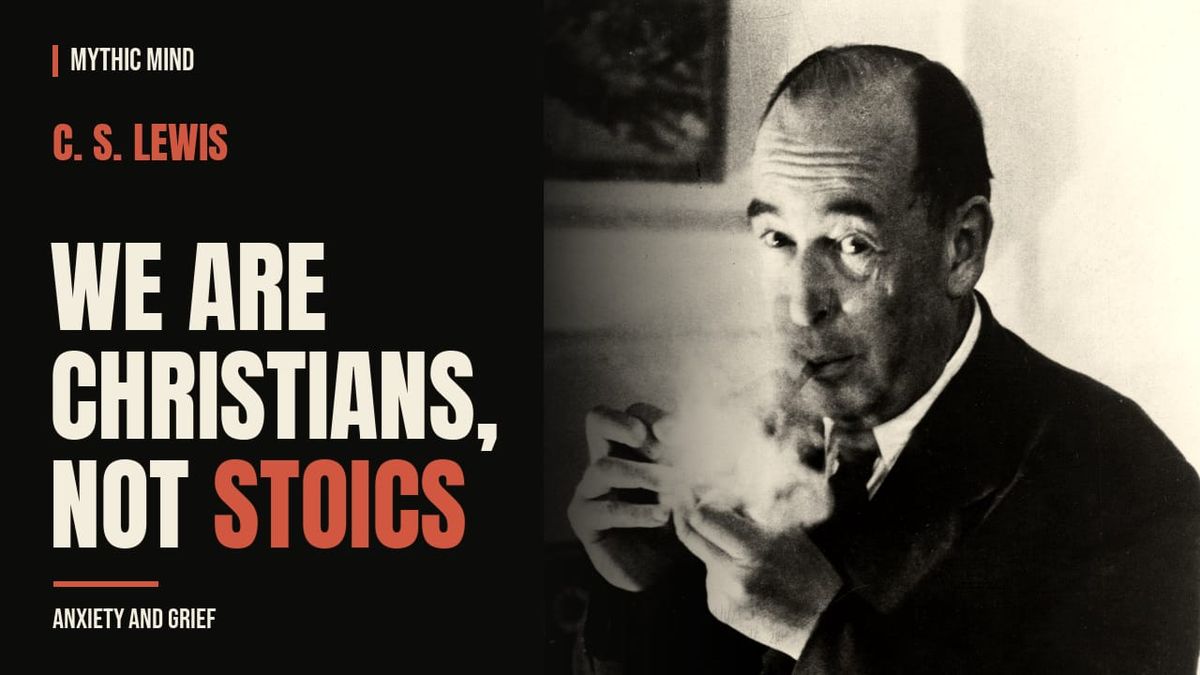
We are Christians, not Stoics: C.S. Lewis on Anxiety and Grief (Mythic Mind, ep. 200)
Many faithful Christians carry two burdens at once: the anxiety itself and the guilt of feeling it. In a public reading of his Inkwell article, Andrew follows C. S. Lewis through Letters to Malcolm and A Grief Observed to show that a Christian may tremble without ceasing to be faithful.

Mythic MindEpisode 200
We are Christians, not Stoics: C.S. Lewis on Anxiety and Grief (Mythic Mind, ep. 200)
In this episode
Many faithful Christians carry two burdens at once: the anxiety itself and the guilt of feeling it. Paul tells the Philippians, “do not be anxious about anything,” and an anxious believer can easily hear that command as an accusation. If I really trusted God, the reasoning goes, I would not feel this knot in my stomach at three in the morning. The anxiety then becomes evidence of spiritual failure, and the guilt feeds the very anxiety it condemns.
This episode is a public reading of an article Andrew recently wrote for the Mythic Mind Inkwell, We are Christians, not Stoics: C.S. Lewis on Anxiety and Grief. He ordinarily keeps these readings for members of the Fellowship. He is making this one available to everyone.
Near the end of his life, C. S. Lewis took up this cycle in Letters to Malcolm: Chiefly on Prayer, a fictional book of letters published in 1964, the year after his death. In the eighth letter he refuses to treat anxiety as a defect of faith. “They are afflictions, not sins,” he writes. “Like all afflictions, they are, if we can so take them, our share in the Passion of Christ.” The Passion begins in Gethsemane, so the dread itself belongs to what the perfect Man accepted, along with the pain that follows it. The Gospel accounts bear this out. Mark says that Jesus “began to be greatly distressed and troubled,” and that he said, “My soul is very sorrowful, even to death.” If the sinless One experienced dread, then dread cannot be the mark of sin. Lewis’s conclusion gives this episode its title: “We are Christians, not Stoics.”
The Stoic sage aims at freedom from the passions, accepting what happens by ceasing to be troubled by it. Christ accepts the cup while troubled to the point of agony. Christian acceptance, as Andrew argues here, is the surrender of the will to the Father in the midst of the feeling. Jesus asks for the cup to pass and submits in the same breath.
Lewis did not write these lines as a spectator. In July 1960 his wife, Joy Davidman, died of cancer, and he later published his notebooks under the pseudonym N. W. Clerk as A Grief Observed. That book is about grief, yet he draws the connection in its opening lines: “No one ever told me that grief felt so like fear.” The most unsettling symptom, he says, was the apparent absence of God: a door slammed and bolted, and then silence. The fear that haunted him most was a dreadful picture of God, the temptation to believe terrible things about him. After one of his bitterest entries he writes, “I wrote that last night. It was a yell rather than a thought.” He comes to see that the mood itself is no evidence, and he is led back to the One who entered the darkness. Gradually the door that seemed bolted begins to open, and the silence changes character.
The man who wrote that anxieties are afflictions had already learned, under the severest trial of his life, that a Christian may tremble without ceasing to be faithful. Paul’s command is completed by an invitation: “in everything by prayer and supplication with thanksgiving let your requests be made known to God,” which is what Christ did in the garden. If the anxiety cannot yet be escaped, it need not be wasted. If we can so take it, it becomes our share in the Passion.
Chapters
- A public reading from the Inkwell
- Anxiety, and the guilt of feeling it
- Letters to Malcolm: afflictions, not sins
- Gethsemane: the sinless One felt dread
- We are Christians, not Stoics
- A Grief Observed
- The apparent absence of God
- A yell rather than a thought
- The door begins to open
- What an anxious Christian can take from Lewis
Choose a chapter to jump the video to that moment.
“We are Christians, not Stoics.”
Go deeper
The Inkwell
We are Christians, not Stoics: C.S. Lewis on Anxiety and Grief
Why anxiety is an affliction rather than a sin, and how Lewis’s own grief shows that faith does not require composure.
Read the essay
Related episode
Kierkegaard’s Concept of Anxiety: Anxiety Is Not an Ailment to Be Removed
Mythic Mind, ep. 196
Watch the episode
Related episode
Introduction to Till We Have Faces: Lewis’s Greatest Novel
Mythic Mind, ep. 113
Watch the episodeFellows and Companions study every course in the Academy, current and future.
View Membership Options