What Is Anxiety? Kierkegaard and the Psychology of Freedom

As humans, we live as time-bound creatures with eternity in our hearts. We long for stability, but live in a world given over to change. We exist in this moving world, yet we also have the responsibility of determining how we exist in it, and how we relate to the moving wheel of fortune. Whether we make this decision intentionally or not, we are making it, and the closer we come to recognizing that, the more acutely anxiety manifests itself. This is why Kierkegaard identifies anxiety as “the dizziness of freedom.”[1] Our anxiety is not first and foremost about anything external, although external circumstance may trigger our awareness of it. According to Kierkegaard, your anxiety is fundamentally about your responsibility to choose. Anxiety, therefore, is not itself good or bad. It is not a disease to be eliminated, but the dis-ease that belongs to the importance of the human decision. Anxiety is ambiguous, even as our future (and our present, for that matter) is ambiguous until the decision is made.
As I mentioned in the last article, Kierkegaard’s psychological framework is very different from the practice of modern empirical psychology. For Kierkegaard, anxiety is not so much a clinical diagnosis as it is a spiritual diagnosis. That does not mean that a Kierkegaardian analysis forgets the reality of the body. To the contrary, in The Concept of Anxiety he emphatically makes the point that to be a human is to be “a synthesis of the psychical and physical.”[2] His primary concern, however, is not what is happening to you, but what you—the you that chooses—are experiencing in relation to your choices. Therefore, while the DSM-5 defines anxiety as “anticipation of future threat,”[3] Kierkegaard identifies anxiety as the experienced “nothingness” of one’s own potential. He does not let us place our anxiety on the future threat, but on the current capacity to choose. As Gregory Beabout explains in Freedom and Its Misuses, “Fear is a relationship to a definite something. Anxiety is the relation between the person and future possibilities, which are a nothingness.”[4] One can be afraid of external threats, as can the beasts, but anxiety is the human spirit’s awareness of the self. “For this reason,” Kierkegaard writes, “anxiety is not found in the beast, precisely because by nature the beast is not qualified as spirit.”[5]
Because anxiety is a constituent of human experience that presses upon us, forcing us into relation with ourselves, the world, and ultimately God, it is experienced as a foreign power that comes uninvited. This power never actually forces a choice upon us. After all, it is ours, or at least it is a revelation of our nature. Anxiety never takes a choice away from us, although we are often inclined to cede our decision-making in anxiety. Even that framing is a self-induced psyop, because the decision to cede our decision-making is itself a decision. There is no getting around this: you are making decisions. The only question is whether you are making decisions that integrate you into a defined self, or decisions that betray your human spirit in despair.
You are not merely a system of synapses and social structures. Yes, your nature, your nurture, your past, and the entire past of the human race bear down on you. You are pushed this way and that by forces outside of your control, and these are the facts of your life. These facts cannot be done away with by romantic idealizations. There is a givenness to the human experience. However, the question remains: What will you do with what you are given? For Kierkegaard, the integrating decision is not to invent yourself, but to rest in the power that established you.[6]
Stay tuned for the next article, in which I will discuss where our most fundamental decisions place us.
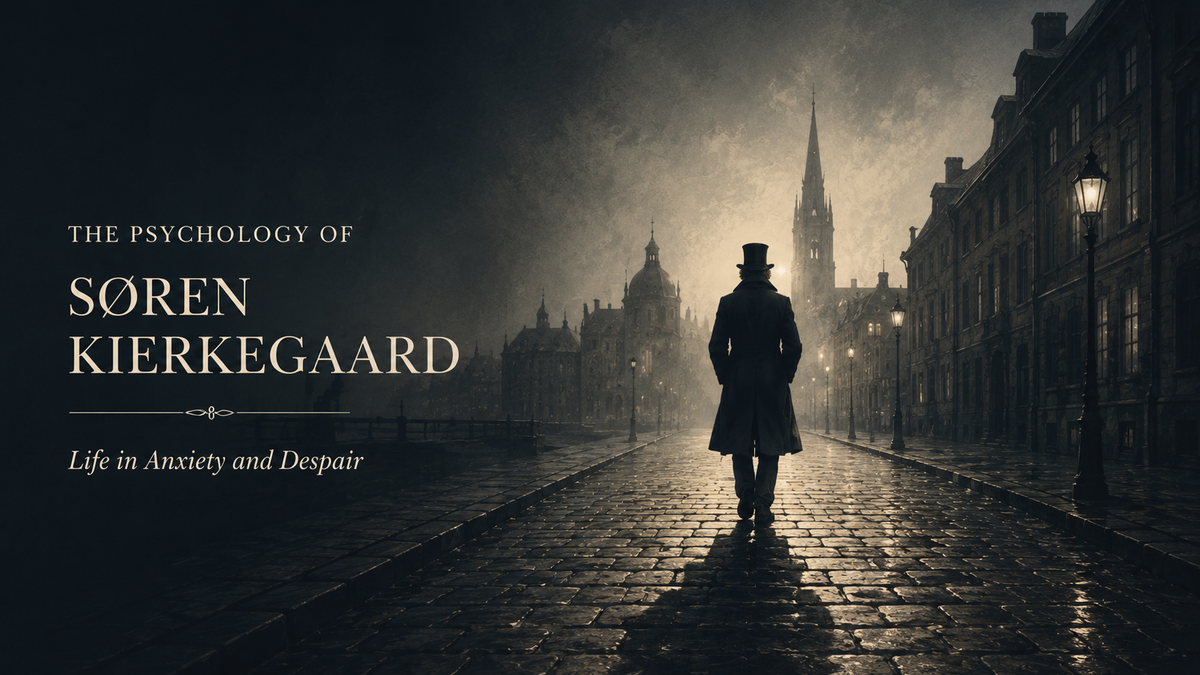
Make sure that you are at least a free member to follow along with the series, and become a Fellow or Companion to participate in the upcoming course, "The Psychology of Søren Kierkegaard: Life in Anxiety and Despair," which begins at the beginning of October. Watch the introductory video and view your membership options below.
Andrew Snyder, Ph.D., is a professor of theology and philosophy, founder of the Mythic Mind Fellowship, and host of all three Mythic Mind podcasts.
[1] Søren Kierkegaard, The Concept of Anxiety, trans. Reidar Thomte (Princeton: Princeton University Press, 1980), 61.
[2] Ibid., 43–44.
[3] American Psychiatric Association, Diagnostic and Statistical Manual of Mental Disorders: DSM-5 (Arlington, VA: American Psychiatric Association, 2013), 189.
[4] Gregory Beabout, Freedom and Its Misuses, 61.
[5] Kierkegaard, The Concept of Anxiety, 42.
[6] Ibid., 161.