
The Necessarily Christian Psychology of Søren Kierkegaard

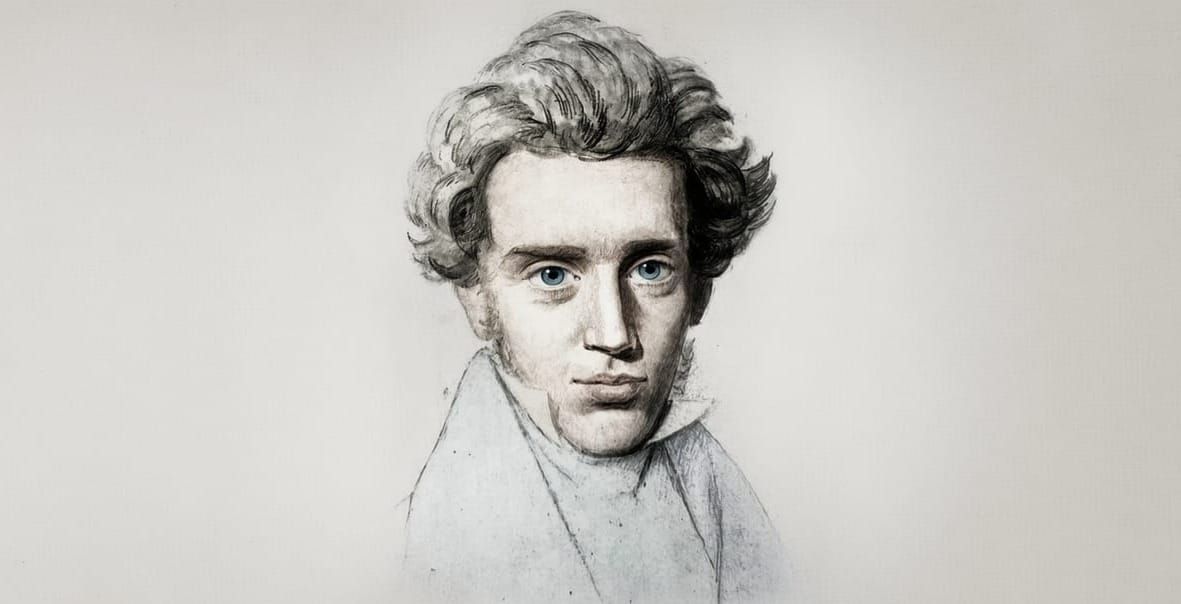
Søren Kierkegaard, the so-called “Father of Existentialism,” is one of the most misunderstood thinkers of modern history. When I was working on my doctoral dissertation, I read countless books and academic articles that treated him as a functional secularist who wore the garb of Christianity but was actually a progressive secularist who preached self-creation along the lines of the French atheist Jean-Paul Sartre. To complicate matters further, much of Kierkegaard's philosophy is explicitly psychological, as he deals with anxiety, despair, and various facets of the inner life. However, his approach to psychology is very different from the practice of modern empirical psychology, which tends to treat individuals in terms of systems rather than spirit and personal responsibility. This means that Kierkegaard's legacy presents a hotbed of issues regarding Christianity and atheism, spirituality and materialism, systems and individuals. In discussions regarding metaphysics and psychotherapy, and the more immediate realities regarding what we do with our chronic anxieties, Kierkegaard provides us with a major battleground for how we understand ourselves.
So, who is the real Kierkegaard, and what, exactly, is his psychological framework?
Vincent McCarthy begins to provide an answer in this passage from Kierkegaard as Psychologist:
For a variety of reasons, therefore, it would be a mistake to call Kierkegaard a psychologist in the contemporary usage of the word. He is neither a trained therapist in one of the established schools nor a social scientist. The laboratory for his experiments is himself, in inward self-examination. He is from the old school of pastoral and literary psychology and brings a definite Christian metaphysics to his analysis. The reality of such things as soul, sin, grace, forgiveness, and the encounter of the human spirit with the divine Spirit are his starting point.[1]
With this passage, McCarthy seems to rightly recognizes the significance of Christian metaphysics for Kierkegaard’s psychology. However, he ultimately relegates this emphasis to an accident of language, regarding Kierkegaard’s core psychology as substantially secular. McCarthy demonstrates this stance on multiple occasions throughout Kierkegaard as Psychologist, such as with his general hermeneutical suggestion that we can “seek a twenty-first-century way to reformulate these [dogmatically-grounded] truths in light of the postmetaphysical prophecy of Nietzsche’s Zarathustra that has largely come to pass…”[2] Likewise, in reference to Kierkegaard’s analysis of despair, he states that, “One does not, however, have to accept the Christian doctrine of sin in order to make sense of what Kierkegaard is saying.”[3] This attempt to secularize Kierkegaard is further seen in his chapter on the relationship between Kierkegaard and Heidegger regarding anxiety, in which he explicitly links Kierkegaard’s concept of anxiety with a Sartrean existence-before-essence anthropology, which is only reasonable if Kierkegaard’s theological presuppositions are discarded. Such an approach does great disservice to Kierkegaard, and consequently to broader conversations concerning philosophy, theology, and psychology, by failing to recognize the foundational role his distinctly Christian presuppositions play in his psychology.
While it is certainly true that individuals might adopt the language of their setting while moving in a fundamentally different direction, I argue in my dissertation that this is by no means the case with Kierkegaard. While his pseudonymous author of The Concept of Anxiety does not claim to be a theologian, he does claim to keep Christian dogmatics "in mente," and it is clear by the end that central arguments in The Concept are ultimately in harmony with what Kierkegaard elsewhere pens with his own name, “To need God is nothing to be ashamed of but is perfection itself, and it is the saddest thing of all if a human being goes through life without discovering that he needs God.”[4]
In the following weeks, I will publish a series of articles that draw from the distinctly Christian psychology of Søren Kierkegaard in discussion of a variety of topics, including anxiety, despair, faith, identity, and how Kierkegaard's approach to psychology relates to contemporary therapy culture.
Make sure that you are at least a free member to follow along with the series, and become a Fellow or Companion to participate in the upcoming course, "The Psychology of Søren Kierkegaard: Life in Anxiety and Despair," which begins at the beginning of October. Watch the introductory video and view your membership options below.
Andrew Snyder, Ph.D., is a professor of theology and philosophy, founder of the Mythic Mind Fellowship, and host of all three Mythic Mind podcasts.
[1] McCarthy, Kierkegaard as Psychologist, 15.
[2] McCarthy, Kierkegaard as Psychologist, 63-64.
[3] McCarthy, Kierkegaard as Psychologist, 144.
[4] Kierkegaard, Eighteen Upbuilding Discourses, 300.