When the Sword Leaves the Stone: An Ocarina of Time Reflection

By Max Holtman
The Legend of Zelda: Ocarina of Time is the only video game with 99/100 on Metacritic, which raises the question: what was so great about the original game, especially regarding its storytelling? As we approach the release of the remake for this 1998 Nintendo classic, I aim to examine the game’s symbolic significance and its relevance to our contemporary culture.
Each Legend of Zelda franchise entry carries with it the same core archetypes: Good versus evil, saving the princess, defeating the dark lord, even pulling the sword from the stone, like King Arthur with Excalibur. It is a variation of the hero myth. By those attributes alone, it sounds very familiar, almost too cliché to be enjoyed. However, Ocarina of Time aligns its setting and player’s perspective to help us recognize how the flow of time molds our beliefs.
It should go without saying that the point of view of a main character should help inform the meaning of a story. Often, the characters’ choices outline the themes of the work. In much of modern storytelling, however, the setting primarily serves the hero’s journey rather than existing as a standalone narrative. In The Last of Us, for example, the post-pandemic United States shapes Ellie and Joel’s present circumstances, but its history ultimately contributes to support their emotional story. The collapse of civilization is important because of the consequences for the characters, but not because the chronology is a standalone, parallel narrative. Yet, there is utility in lore building to help give a story depth, and one can find a clear jumping off point in popular ‘good vs evil’ stories.
Luke Skywalker goes from the barren desert of Tatooine to the many planets of the galaxy. Harry Potter goes from being the boy under the stairs to the boy wizard at Hogwarts, the school with the moving stairs. The beliefs emerge from lived experiences, the encounters with their adversaries and allies. They live an adventure, but one of moral choices and conflict. The gamer who picks up Ocarina of Time and plays as the hero character, Link, is shaped by the changing virtual world just as much as by what directly happens to Link within the game.
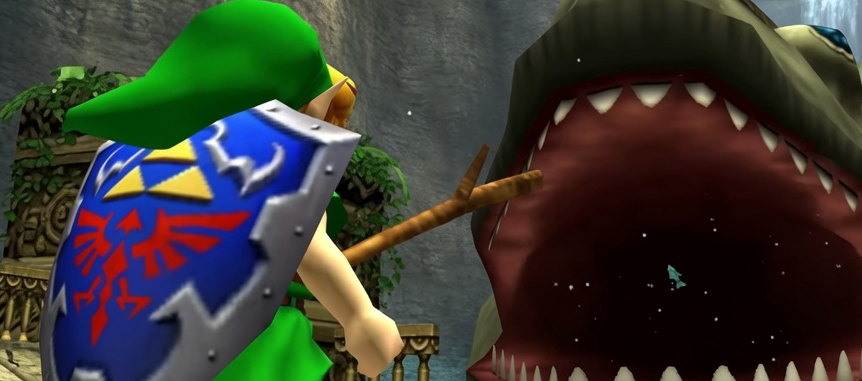
At the start, we see that Ocarina of Time pulls from the visual cues of Disney’s Peter Pan. Young Link begins as a boy in a green tunic, the only child in the forest without a fairy. He lives in a forest with other children that never grow up. They are hidden from the dangers of the world in the safe haven of the old forest spirit, The Great Deku Tree. But the tree is dying and the dark lord Ganondorf is coming. Young Link sets off on his adventure to save the kingdom of Hyrule. There is a visual pattern similar to the Book of Jonah in the Old Testament where a child enters the belly of the beast. The first three dungeons of Ocarina of Time involve entering the mouth of a large being or monster (Inside the Great Deku Tree, Dodongo’s Cavern, and Jabu Jabu’s Belly).
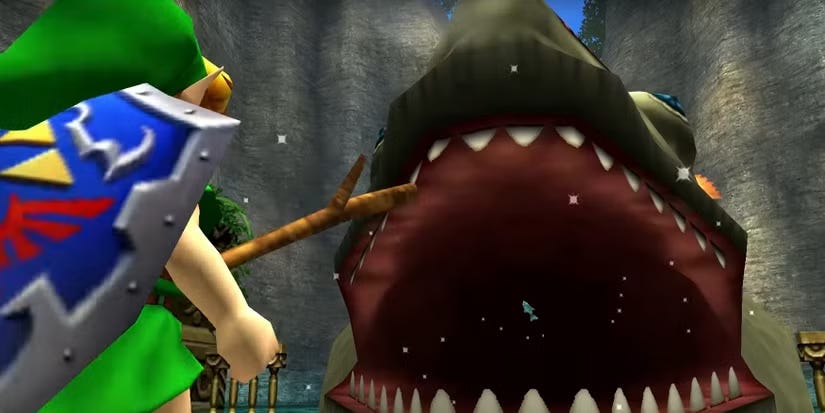
*As a side note, game design, much like traditional storytelling, follows a ‘rule of threes’. This game has a similar moment to the story of Jonah. He is trapped for three days and three nights in the belly of the whale. In Ocarina of Time, Jabu Jabu is a massive whale creature and patron guardian deity. Link is pulled into the mouth of Jabu-Jabu. There are three dungeons you must clear to obtain the three spiritual stones. You also see a similar, slightly inverse image of this idea in Harry Potter and the Chamber of Secrets. The Basilisk snake creature slithers out of the mouth of the Salazar Slytherin statue. The golden snitch also falls out of Harry’s mouth after he catches it at the Quidditch game. While these are not likely intentional callbacks to a singular mytholigical reference, they are patterns common in fairytales that reveal an early catalyst of change for a character, but not any mark of hardened moral sacrifice or the human suffering of a powerful, mature hero. Ancient mythology and fairy tales work in reinforcing an action with a divine creature.
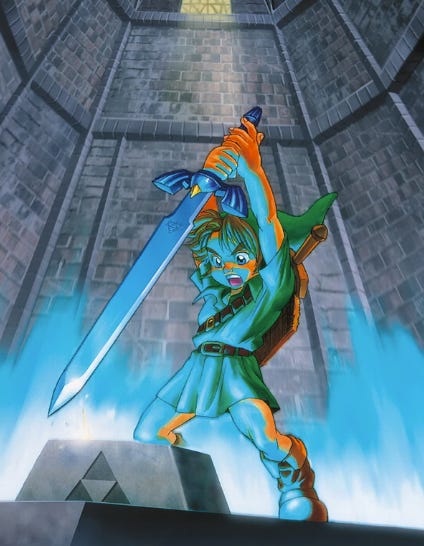
As the story progresses, young Link enters adulthood by pulling the Master Sword from the stone in Hyrule Castle’s Temple of Time. This is an image of destiny. He is willing to risk his life (and ultimately the rest of his childhood by skipping it) as a sacrifice for the sake of the world. Instantly, it is clear that this world he entered seven years later as Adult Link is the opposite of the world he once knew. Ganondorf has nearly destroyed Hyrule. Its people are zombies, ghosts roam Hyrule Field, and the dungeons are far darker and more dangerous.
The whimsical atmosphere and sense of peace that Hyrule had are completely gone. Instead, the game’s later dungeons reflect a lost history of Hyrule kingdom and hint at the suffering in echoes of its troubled past.
For example, the surreal cult chants in the soundtrack of the Forest Temple emit the tone of a mystical forgotten area and ominous atmosphere. It is a strong fortress that was clearly once inhabited by magic wielding beings, where ghosts fade in and out of painting frames. Much is left to interpretation, but through excellent sound design and visual in-game textures, it suggests that this liminal space shouldn’t be accessed if one were to dive into this place’s ancient history. It feels as though the game has allowed you to see something that was never intended to be seen by the other inhabitants of Hyrule.
Oftentimes in video games, the entrances to these flagship landmarks tell us a lot about symbology. The bottom of the well, the bottom of the lake, and the inside of Death Mountain canyon are all dungeon locations. These places are hard to find by common means, as is evident in the names. They are hidden intentionally or indirectly to obscure truth, hide pain, or mask evil doings.
This works in the reverse direction, too. What is sacred is usually hidden. The Door of Time in Hyrule Castle protects the sacred realm, a divine dimension created by the goddesses. No soul can waltz through the door, even if they claim to be of high earthly status or strong moral character. Access to this place in the wrong hands can result in catastrophe. Darkness has its own sinister motivations to cloak itself, just as the light has enforced its own proper layers of protections.
These are also common psychological patterns in our own dreams, revealing what we protect or what we hide. These are the unconscious layers of doors we are opening, abstract spaces that contain people and ideas, which lead us to funny or strange places. Pushing against evil can also be met with this kind of structural resistance. A foe may enforce their narrative with lies and hide something deep so that it takes much digging to find it, and even then, it might be too late.
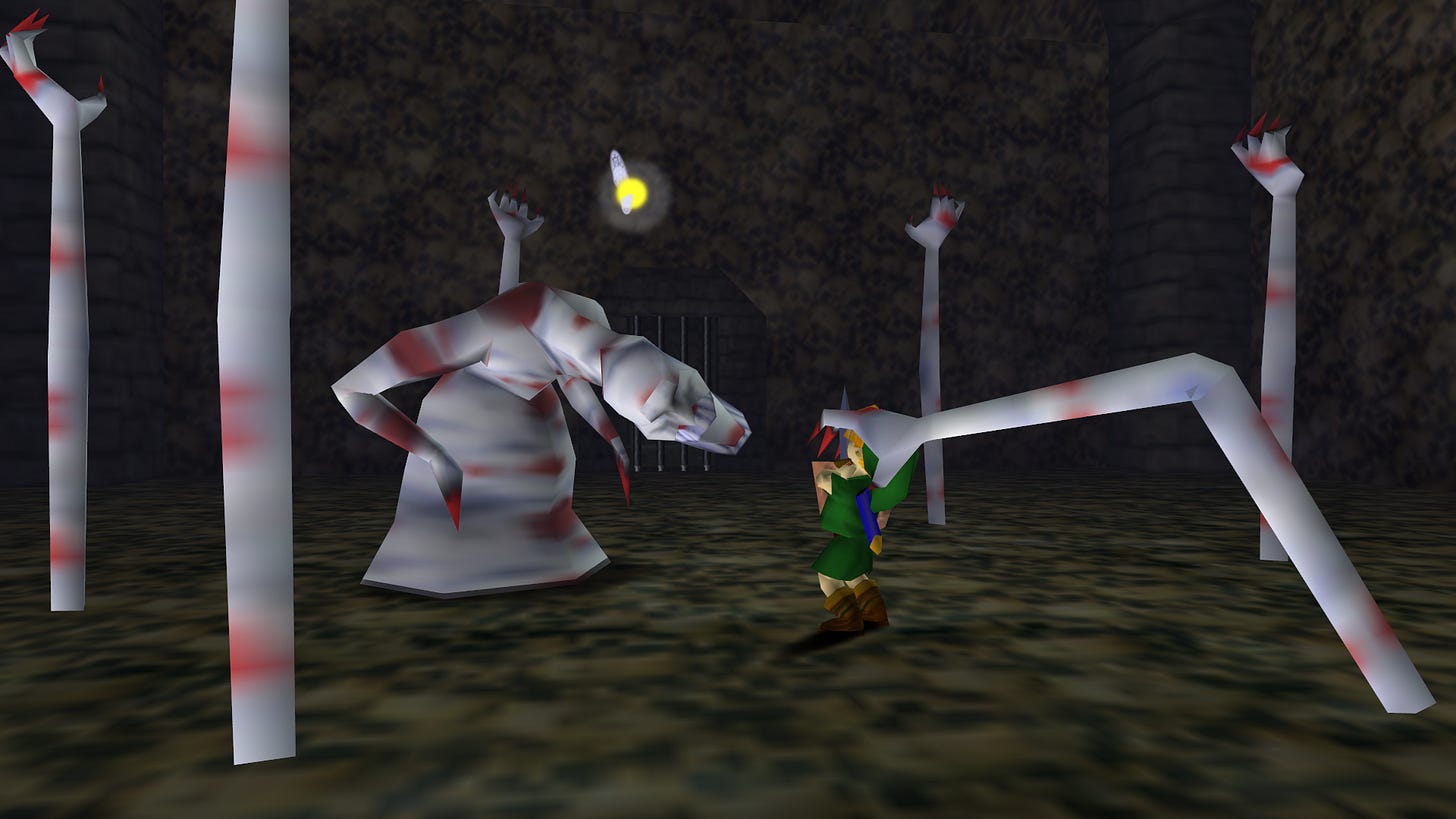
Ocarina of Time is a story of two halves, a life split into two phases. A life from a child who saw the innocent joy of others, and the thrill of the adventure almost as a form of play. He saw Hyrule Market brimming with joy, Lon Lon Ranch’s peace with nature as Malon sang and horses galloped on the pasture. But with the flow of time, these fruits of life didn’t survive in darkness. The adult Link saw suffering, the loss of what’s good, the evil enclosing Hyrule. He saw the heavy sacrifices that were needed to keep the pain at bay. His worldview of Hyrule totally shifted after he pulled the Master Sword from the stone.
Is this not how a human being shifts as they age? Our culture is heavily invested in nostalgia. Social media algorithms feed us images of old toys we had and what Christmas in our neighborhood used to feel like. We witness the joy of other children with the same youthful purity of heart, and we think back to when we were once children, when things were easier. But with growth comes pain, mistakes, death, sin. Perhaps new and old Zelda fans will rediscover in 2026 what this game is trying to tell us — You don’t look at the world the same way at 28 as you do at 8 — but maybe, in some ways, you should.
Young Link exhibited strength and courage despite such a low experience level — the same courage of Samwise Gamgee, or even Neville Longbottom standing up to the evil snake Nagini. It is worth noting how these popular stories promote young (and oftentimes naive) courage as a virtue, even if you aren’t necessarily as trained or skilled as someone older or with greater feats. This should teach us that the pessimistic, hyper rationalist post-modern beliefs should not be inherent or always morally justified, especially when courage and faith exist as the only plausible antidotes to the broken world we live in.
Christ taught that to enter the kingdom of Heaven, people must ‘change and become like little children’. At first it almost seems like bad advice, as children do not hold wisdom or much life experience. Why not become powerful leaders of men or influential figures of this world?
It is imperative to not mistake this calling to ‘become like little children’ as a pass to become impulsive or spoiled. Discipline and experience are still important. Instead, it is a calling to re-connect with the part of your inner soul that you recognized when you were a child: the part that first recognized the highest values in life, like love and friendship, the part that can recapture the magic of the world that was faded with life’s complicated obligations. Be like Young Link, recognizing the joy yet still holding steadfast in courage, and be willing to sacrifice. To have child-like faith is to keep to the simple yet eternal truth of hope and to remember what is worth fighting for.
Max Holtman is a software developer and musician from the Midwest who writes about games and movies. Max can be found on X at maxholtman, on YouTube at max_music, and at [email protected].
Join the Mythic Mind Fellowship to discuss books, games, film, and philosophy and to write for the Inkwell.



